Practical guides
Bullpen DeFi is a MEV-protected trading workspace for the onchain economy
Bottom line: All-in-one onchain trading app for tokens, perps, and prediction markets, with Jupiter Ultra execution and real-time Jito tip routing.
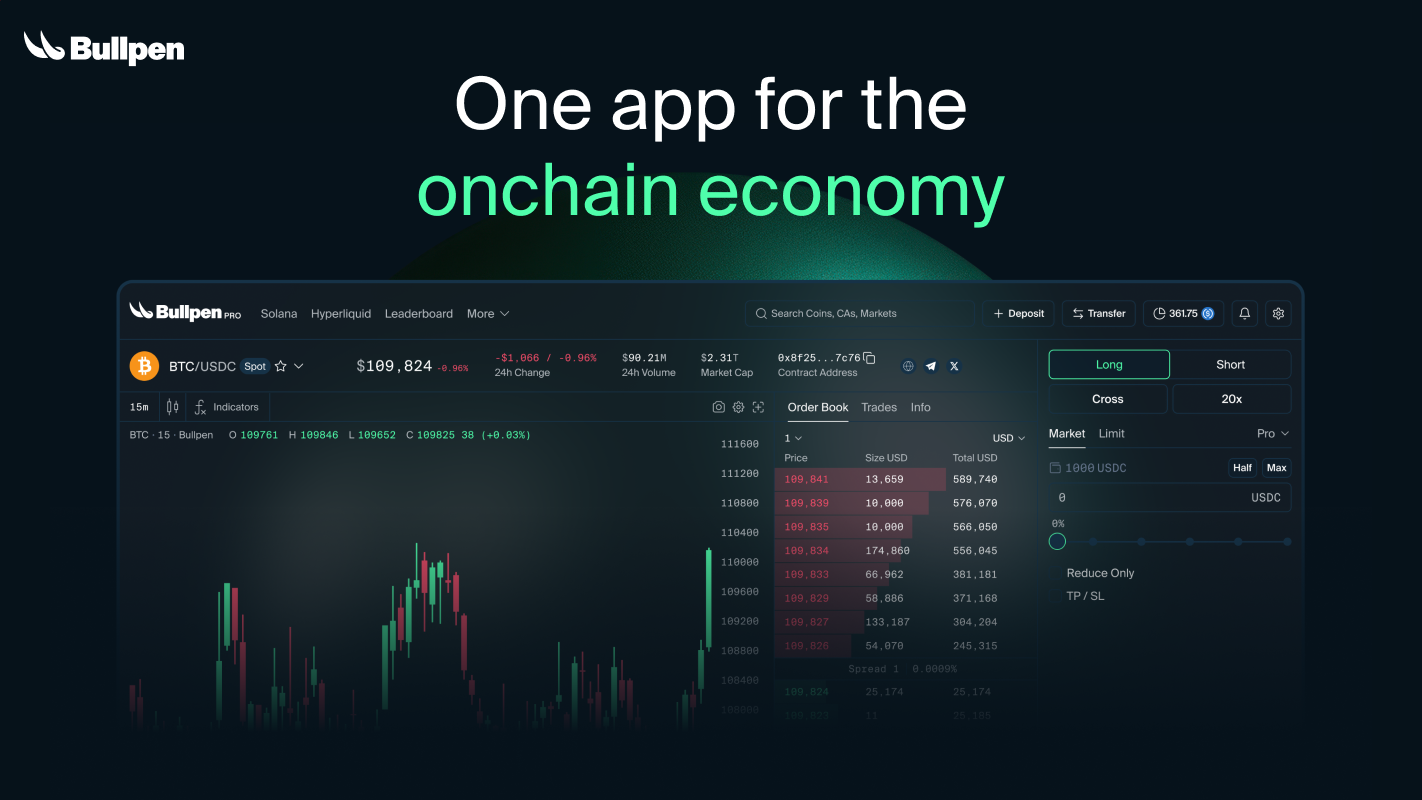
Bullpen defi is a unified crypto trading app for tokens, perpetual futures, and prediction markets, with execution designed around Jupiter Ultra, Hyperliquid data, real-time priority fees, Jito tips, and slippage control. It brings discovery, order entry, wallet management, and social performance into one interface, so a trader moves from market signal to routed transaction without jumping between a token scanner, a swap screen, a perp terminal, and a social feed.
Jito tip routing is the trading detail that matters first
The distinctive part of the experience is transaction landing. On Solana, a swap is not just a price quote; it also has to reach the chain at the right priority level while avoiding poor execution and unnecessary extraction. Bullpen defi uses real-time routing around priority fees, Jito tips, and slippage so the buy button does more than submit a raw transaction. The app handles the execution parameters that active traders otherwise tune manually during volatile moves.
That matters most when new tokens move quickly. A delayed fill, a rejected transaction, or excessive slippage changes the actual entry far more than a clean quote shown seconds earlier. MEV protection, faster landing, and tighter transaction settings turn the interface into a practical trading cockpit rather than a passive portfolio screen.
What the unified interface brings together
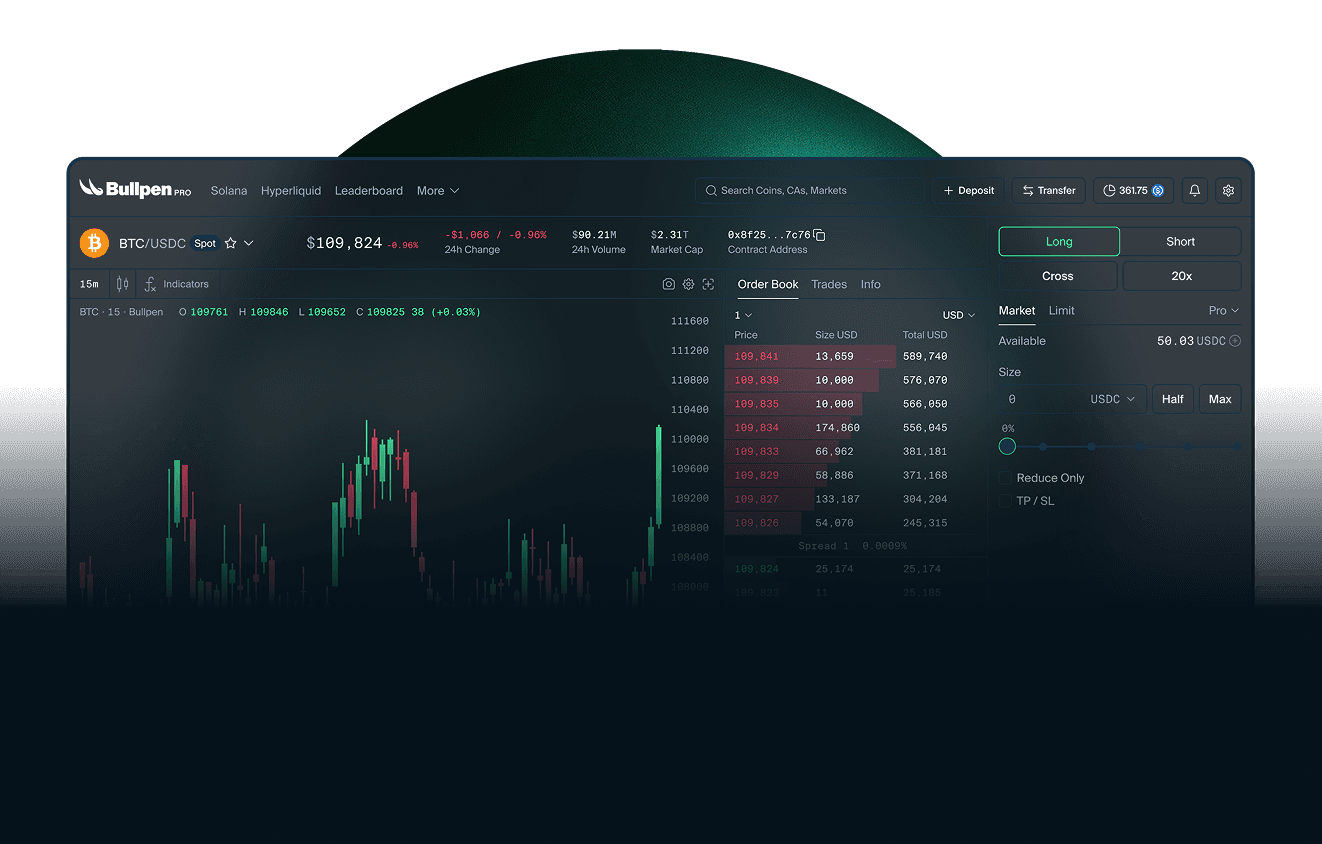
The product is built around a simple idea: token trading, perps, prediction markets, wallet access, and trader discovery belong in the same workflow. A user sees market opportunities, opens a trade, tracks positions, and shares performance without passing custody to a centralized exchange. The app supports SVM and EVM wallet imports, which matters for traders who hold assets across Solana and Ethereum-style networks.
Perpetual futures activity connects to Hyperliquid, while token execution is presented through Jupiter Ultra. Prediction markets add a different style of directional trading where the market is an event rather than a token chart. Those three lanes create a broader onchain trading surface than a basic swap app, while the interface keeps the action centered on orders and market discovery.
How Jupiter Ultra execution fits into token trades
Jupiter Ultra is the execution layer named for swaps, and it gives Bullpen defi a concrete route into Solana liquidity. The trader selects a token and trade size, while the app optimizes the transaction path, slippage, priority fee, and Jito tip behavior in real time. The goal is fast, clean settlement without adding extractive platform fees on top of the trade.
Limit orders and DCA orders extend the same trading surface beyond immediate buys. A limit order suits entries where price discipline matters, while DCA orders split accumulation into repeated purchases. The official positioning says these advanced order types are available at no additional cost, which makes them part of the everyday workflow rather than a separate professional tier.
Runners, Whales, and Hyperliquid Insights turn discovery into action
Discovery is treated as a trading function, not a content sidebar. Runners is aimed at breakout tokens before they dominate social conversation. Whales highlights smart money inflows and what large wallets are buying. Hyperliquid Insights surfaces net positioning, open interest, and volatility metrics so perp traders judge crowdedness and momentum before entering a position.
These features give Bullpen defi a research loop around the execution screen. A trader notices wallet accumulation, checks whether a token is starting to run, reviews positioning data where relevant, then places a market, limit, or DCA order. The value is the compression of steps: fewer tabs, fewer disconnected dashboards, and less delay between signal and transaction.
Starting with wallets, ACH, and synced sessions
Getting started begins with wallet access. The app is designed for users to bring SVM and EVM wallets into one place, which keeps the workflow broad enough for Solana assets and EVM holdings. Browser sessions sync with mobile-friendly notifications, so monitoring does not stop when the desktop tab closes.
Bank connectivity is part of the stated onboarding path as well. Same-day ACH deposits and withdrawals are positioned as a way to move between bank rails and onchain trading without first using a centralized exchange account. That feature is especially relevant for users who want fiat access but still want the trading venue, wallet layer, and public performance features to remain onchain-oriented.
Public performance changes the social layer
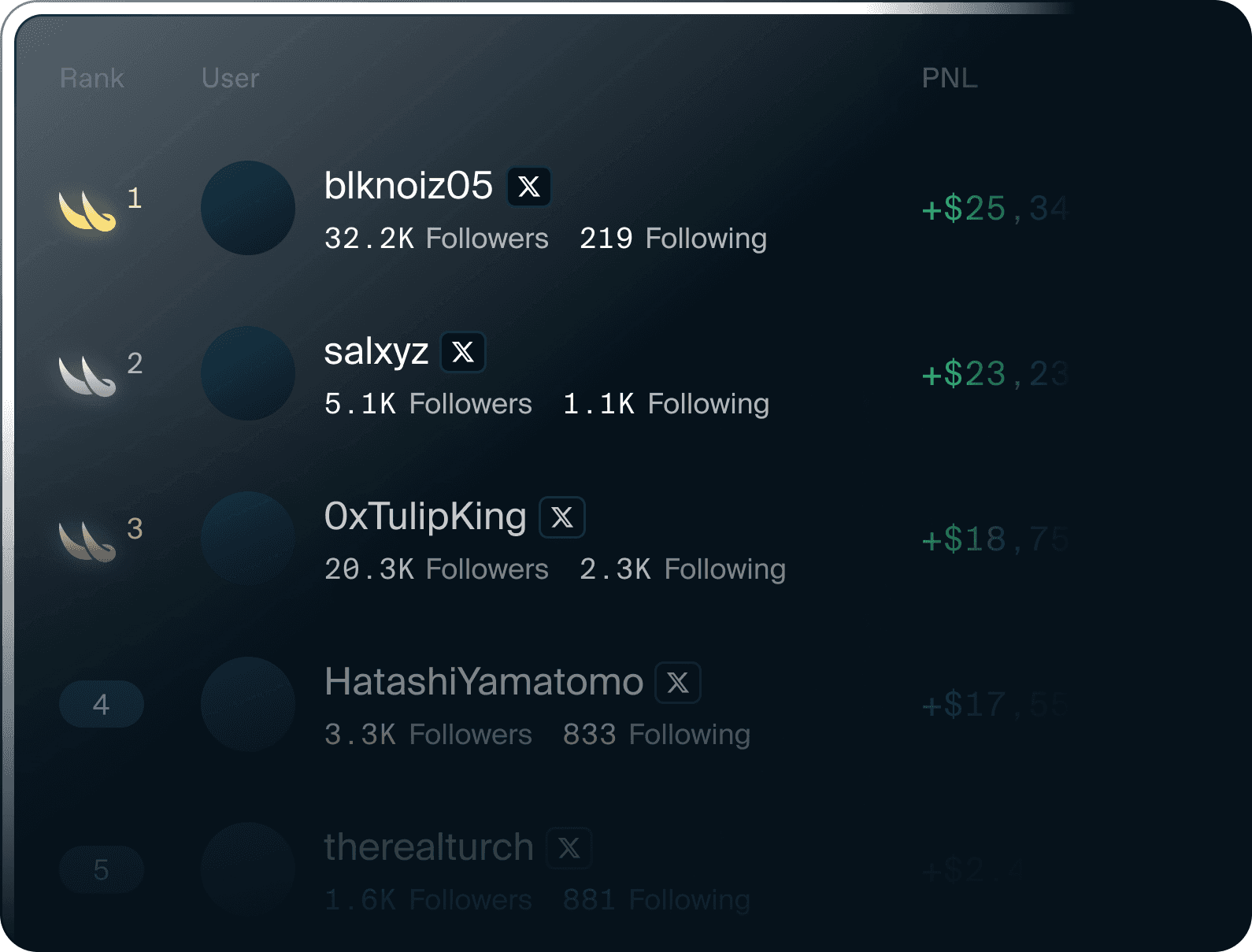
Social trading is not only a feed of opinions. The app emphasizes visible positions, leaderboards, followers, and one-tap sharing to X. Traders can follow strong performers, study current positions, and publish their own trades. $BULL points are tied to sharing alpha, giving the social layer a gamified reward structure rather than leaving reputation entirely to screenshots and claims.
This is where Bullpen defi separates itself from a plain execution terminal. Public performance makes the trading record part of identity. A leaderboard gives skilled traders a way to build distribution, while observers gain a cleaner way to evaluate who is actually taking risk. The stronger signal comes from positions and outcomes, not just confident posts.
Where tokens, perps, and prediction markets each fit
Token trades suit spot exposure: buying a new Solana asset, rotating between memecoins, or accumulating a position through DCA. Perps suit leveraged directional views on liquid markets, with Hyperliquid data helping frame open interest and volatility before a trade. Prediction markets suit event-driven views where the payoff depends on an outcome rather than the price of a coin.
Using all three in one interface makes the app useful for active traders who follow narratives across venues. A market event might move a token, shift perp positioning, and create a prediction market opportunity at the same time. Bullpen defi is built for that style of onchain activity, where discovery, timing, and settlement quality all affect the trade.
Execution benefits and the risks worth respecting
The main benefit is fewer weak points between idea and order. The app combines optimized transaction landing, MEV protection, advanced orders, wallet imports, and performance discovery. Fast fills and lower explicit platform costs matter, but the larger advantage is operational: a trader spends less time assembling tools and more time judging whether the trade deserves capital.
Onchain trading still exposes users to wallet permissions, volatile assets, liquidation risk on perps, and thin liquidity in smaller markets. Before using Bullpen defi for size, a trader should understand the selected order type, the wallet being used, and the difference between spot token exposure, leveraged perps, and event-based prediction markets.
When another trading setup makes more sense
A basic wallet swap works for someone who only buys occasional tokens and does not need public performance, DCA, or market discovery. A dedicated perp terminal suits a trader who lives entirely inside leveraged futures and wants the deepest single-venue controls. A centralized exchange remains familiar for users who prioritize custodial account recovery and conventional order books.
Bullpen defi fits the trader who wants onchain execution, social proof, Solana routing, Hyperliquid context, and wallet portability in one place. Its strongest use case is not passive holding; it is active participation in fast crypto markets where execution quality and discovery speed sit next to each other.
Helpful answers about Bullpen defi
Fees on Bullpen defi: what costs should traders expect?
The app promotes fast fills without extractive platform fees, and its limit and DCA orders are described as available at no additional cost. Traders still face the normal costs of onchain execution, including network fees, priority fees, Jito tips, and price movement from slippage. Perp and prediction market costs also reflect the venue and market structure behind those products.
Which market data does Bullpen defi show for Hyperliquid traders?
Its Hyperliquid Insights feature highlights net positioning, open interest, and volatility metrics at a glance. Those data points help traders understand whether a perp market is crowded, expanding, or moving through a volatile period. The feature is designed to sit near execution and discovery rather than requiring a separate analytics dashboard.
Why do Jito tips matter for Bullpen defi swaps?
Jito tips help transactions compete for landing priority on Solana. In a fast market, the difference between a landed swap and a delayed or failed transaction changes the actual entry price. The app automatically adjusts Jito tips, priority fees, and slippage in real time so the trader does not have to tune those execution settings manually.
Is Bullpen defi useful without sharing trades to X?
Yes. Sharing trades to X and earning $BULL points is part of the social layer, but the core trading workflow still covers tokens, perps, prediction markets, wallet imports, order types, and execution routing. Users who do not want a public persona can still use the app for market discovery and order placement.